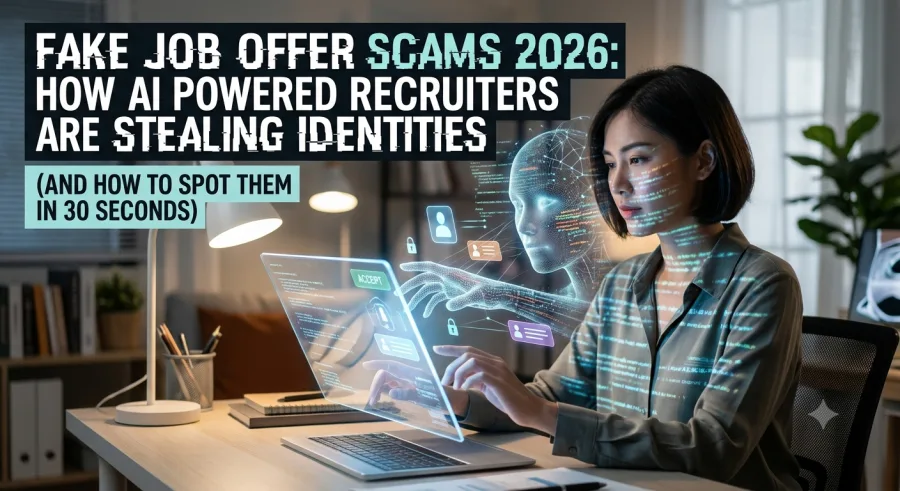
Fake Job Offer Scams 2026: How AI Powered Recruiters Are Stealing Identities (And How to Spot Them in 30 Seconds)
If you have been job hunting recently and received a message that felt almost too good to be true, slow down before you reply. A polished recruiter profile, a fast track interview, and a job offer that lands within days of your first chat are no longer signs of luck. In 2026, they are increasingly signs of a scam built with generative AI.
Fake job offer scams have quietly become one of the fastest growing categories of online fraud. Unlike older versions of this scam, which relied on poorly written emails and obvious red flags, today's attacks use AI generated profiles, cloned company branding, and even AI voice interviews to convince victims they are speaking with a real employer. The goal is rarely just to waste your time. It is to steal your personal information, your money, or both.
Why This Scam Is Spreading So Fast
According to data released in the 2026 Global Identity Threat Report, AI-driven recruitment fraud has surged by over 45% in the last year alone, with remote tech and administrative roles being targeted heaviest.
Three things changed that made fake job scams explode in 2026.
First, generative AI made it trivial to create convincing recruiter personas. A scammer can generate a professional headshot, write a fluent LinkedIn bio, and reply to messages in natural sounding language within minutes. There is no longer a language barrier or an obvious AI generated photo to give it away.
Second, remote work normalized never meeting an employer in person. Five years ago, a job offer without a single video call or office visit would have raised eyebrows. Today, fully remote hiring is standard, which gives scammers cover to avoid any verification step that would expose them.
Third, economic uncertainty has pushed more people to apply for jobs aggressively and respond quickly to opportunities. Scammers know that urgency lowers your guard, and a tough job market makes people less likely to question a recruiter who reaches out first.
How the Scam Actually Works
Most fake job offer scams follow a similar pattern, even though the details vary by industry and platform.
It usually starts with an unsolicited message on LinkedIn, WhatsApp, Telegram, or even text message. The recruiter claims to represent a real, often well known company, and the role sounds attractive: high pay, flexible hours, remote work. The profile photo looks professional, the company logo appears correct, and the messaging tone is friendly but efficient.
The interview process moves unusually fast. Some scams skip interviews entirely and go straight to an offer letter. Others include a short chat interview or a recorded video call using an AI generated avatar or voice, which is harder to detect than people expect.
Once you are "hired," the scam shifts into one of a few directions. You might be asked to purchase equipment such as a laptop or software license, with a promise of reimbursement that never comes. You might be asked to complete an onboarding form that collects your full name, date of birth, social security or national ID number, and banking details, which are then used for identity theft. In some cases, you are asked to deposit a check for a signing bonus and send part of it back for "training fees," a classic check fraud setup that leaves you liable once the check bounces.
Red Flags That Should Make You Pause
A few warning signs tend to show up across almost every version of this scam.
The recruiter reaches out to you first, especially for a role you never applied for, and the opportunity seems unusually well paying for the effort involved. Communication happens entirely through personal messaging apps rather than a company email address or official career portal. The hiring process moves at a pace that feels rushed, with little to no live interaction, or with interactions that feel slightly off, such as a video call where the person's voice does not quite match their lip movements.
You are asked to pay for anything upfront, whether it is described as equipment, training, a background check fee, or software access. Legitimate employers do not ask new hires to pay money before their first paycheck. You are also asked to provide sensitive personal or financial information very early in the process, often before any formal offer letter or contract has been signed.
How to Verify a Job Offer Is Real
Before you share any information or accept any offer, take a few minutes to confirm who you are actually talking to.
Go directly to the company's official website by typing the URL yourself, rather than clicking a link sent to you. Check their careers page to see if the role is actually listed there. If it is not, that is a major red flag.
Search for the recruiter's name along with the company name. Most legitimate recruiters have a consistent presence across LinkedIn, the company website, and sometimes press mentions. A profile that was created recently, has very few connections, or has no posting history beyond recruiting messages is worth treating with suspicion.
Look closely at the email domain used for any official communication. Scammers often use domains that look almost identical to the real company's domain but contain a subtle difference, such as an extra letter, a different top level domain, or a hyphen that the real company does not use. This is the same lookalike domain technique used in many phishing campaigns, and it applies just as much to fake job offers as it does to fake login pages.
If a video interview feels strange, ask a question that requires a spontaneous, unscripted response, and pay attention to whether the audio and video stay in sync. AI generated avatars and voice clones have improved significantly, but real time conversation under pressure still tends to expose inconsistencies.
For example, a real recruiter from a company like Amazon will always email you from an address ending in @amazon.com. A scammer, however, might purchase and use a lookalike domain like @careers-amazon.com or @amazon-recruitment.cc. To the untrained eye passing through a busy inbox, the difference is practically invisible.
What To Do If You Suspect a Scam
If something feels off, do not provide any further information and stop responding. Do not click on any links sent through chat apps, and never download software or "onboarding tools" sent outside of a verified company portal.
If you have already shared sensitive information such as a national ID number or banking details, contact your bank immediately, place a fraud alert with credit bureaus where applicable, and monitor your accounts closely for unusual activity.
If you received a check as part of a signing bonus scam, do not deposit it, and report it to your bank. Banks are familiar with this pattern and can often flag the check before it causes damage if you report it early.
Finally, report the fake job listing or recruiter profile to the platform it appeared on, whether that is LinkedIn, a job board, or a messaging app. Reporting helps get fraudulent accounts removed before they reach other job seekers.
The Bigger Picture
Fake job offer scams are part of a broader trend where AI is being used to make social engineering attacks faster, cheaper, and far more convincing. The same techniques used to clone a recruiter's voice or generate a fake company profile are being used across romance scams, executive impersonation, and brand spoofing attacks targeting customers of real businesses.
For job seekers, the best defense is the same advice that applies across all of these scams: slow down, verify independently through official channels, and treat any request for money or sensitive information as a reason to stop and double check, no matter how convincing the conversation feels.
For businesses, the lesson is just as important. If scammers can convincingly impersonate your recruiters, they can just as easily impersonate your support team, your executives, or your login pages. Monitoring for lookalike domains and fake profiles using your brand name is no longer optional, it is a basic part of protecting both your company and the people who trust your name.
Is your brand being impersonated?
PhishPin finds lookalike domains, fake profiles and phishing kits that copy your brand - and gets them taken down. Get a confidential 24-hour audit.
Get my free audit