The Dark Corporation: Why Cybercrime is Operating Like a Silicon Valley Startup
We often imagine a cybercriminal as a lone wolf in a dark basement, wearing a hoodie and typing frantically. That image is not just outdated—it’s dangerous.
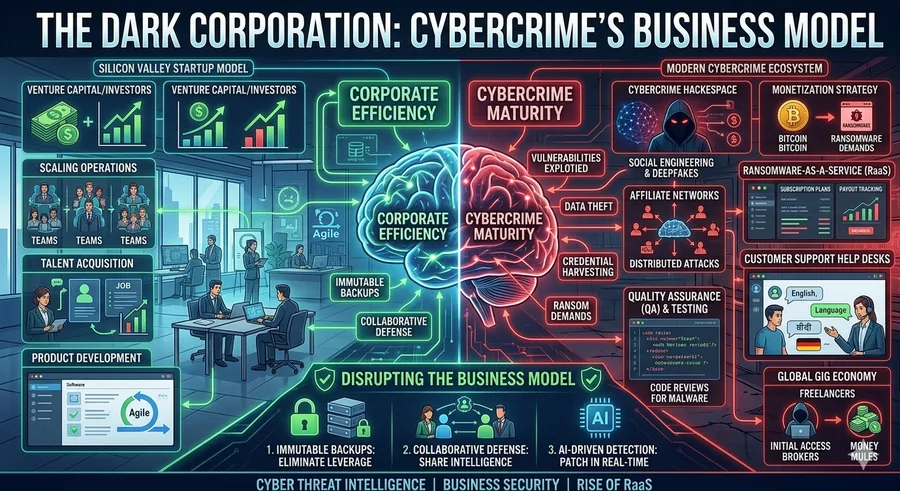
In 2026, cybercrime has undergone a massive digital transformation. It is no longer just a series of random attacks; it is a trillion-dollar industry modeled after the world’s most successful tech giants. To protect your data, you have to understand that you aren't fighting a hacker; you’re fighting a highly efficient corporation.
The Rise of "Ransomware-as-a-Service" (RaaS)
Just as you might subscribe to Microsoft 365 or Salesforce, criminals now subscribe to Ransomware-as-a-Service.
Top-tier developer groups build the malicious code and then "lease" it to affiliates. These affiliates don't even need to know how to program; they simply handle the distribution. The developers take a 20-30% cut of every successful ransom payment. This division of labor has allowed cybercrime to scale at a rate that traditional security teams are struggling to match.
24/7 Help Desks for Victims
Perhaps the most surreal part of modern cybercrime is the Customer Support.
When a company is hit with ransomware, the "hackers" often provide a live chat link. On the other end isn't a bot, but a professional support agent who will:
Walk you through how to buy Bitcoin.
Provide "discounts" if you pay within the first 24 hours.
Offer technical assistance to ensure your files are decrypted correctly once the payment is made.
They realize that if they have a reputation for not returning files, victims won't pay. They are protecting their "brand equity."
The "Gig Economy" of the Dark Web
The dark web now features job boards that look remarkably like LinkedIn or Upwork. Groups post "job openings" for:
Initial Access Brokers: Specialists who find a "hole" in a company’s network and sell that entry point to the highest bidder.
Quality Assurance (QA) Testers: People whose only job is to ensure the malware isn't detected by common antivirus software before a launch.
Money Mules: A global network of "contractors" who move stolen funds through complex crypto-mixers.
How to Disrupt the Business Model
You cannot defeat a corporate-level threat with individual-level awareness alone. To win, we must make the "cost of doing business" too high for the criminals.
Immutable Backups: If your data is backed up in a way that cannot be deleted or encrypted (air-gapped), the attackers lose their leverage. No leverage means no profit.
Collaborative Defense: Criminals share intelligence; businesses must do the same. Joining industry-specific threat-sharing groups turns a "private problem" into a "collective defense."
AI-Driven Detection: If they are using AI to find vulnerabilities, you must use AI to patch them in real-time. The goal is to make the "hack" take more time and resources than the potential payout is worth.
The Bottom Line
Cybercrime has moved from the basement to the boardroom. By viewing these threats as professional business operations rather than random acts of digital vandalism, we can better predict their moves, secure our assets, and ultimately, bankrupt the "Dark Corporation."
Is your brand being impersonated?
PhishPin finds lookalike domains, fake profiles and phishing kits that copy your brand - and gets them taken down. Get a confidential 24-hour audit.
Get my free audit