Your Smart Home is Watching You: The Hidden Dangers of the IoT Revolution
In 2026, the average home is smarter than ever. From refrigerators that order milk to thermostats that learn your schedule, our lives are defined by convenience. But there is a dark side to this connectivity that social media is just starting to wake up to: every "smart" device in your house is a potential door for a cybercriminal.
With over 29 billion IoT devices expected to be online globally by 2030, we aren't just living in smart homes; we are living inside giant, vulnerable attack surfaces.
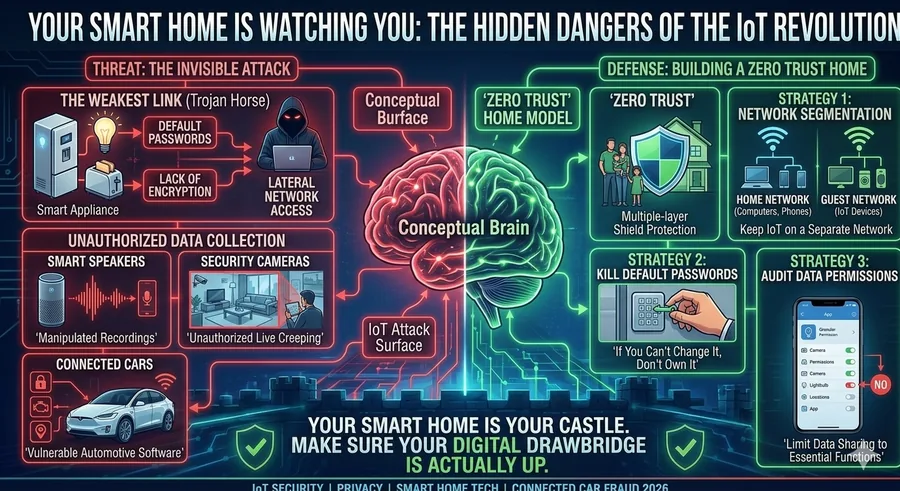
The "Trojan Horse" in Your Kitchen
Why would a hacker want to break into your smart toaster? They don't care about your toast. They care about your network.
IoT devices are often the "weakest link" in your digital security. Many come with hardcoded passwords that users never change, and most lack the robust encryption found on smartphones or laptops. Once a hacker gains access to a single vulnerable device—like a smart lightbulb or a baby monitor—they can move laterally through your network to reach your laptop, your bank accounts, and your personal data.
Real-Time Surveillance: When Your Home Snitches
One of the most trending concerns on platforms like X (formerly Twitter) and Reddit is the rise of unauthorized data collection. Many IoT devices are designed to "listen" or "watch" to function correctly, but without proper transparency, that data can be intercepted.
Smart Speakers: Can be manipulated to record private conversations.
Security Cameras: Vulnerable to "creeping," where attackers gain a live feed of your private life.
Connected Cars: Modern vehicles are essentially giant IoT devices. Hackers are now targeting automotive software to control everything from door locks to engine timing.
The "Zero Trust" Home: How to Lock the Digital Doors
You don't have to throw away your smart tech, but you do have to stop trusting it blindly. In 2026, the Zero Trust model is moving from the office to the living room.
Segment Your Network: Keep your "smart" devices on a separate guest Wi-Fi network. This way, if someone hacks your fridge, they can't jump to the computer you use for work.
Kill the Default Password: If a device doesn't let you change its password, it shouldn't be in your house.
Audit Your Permissions: Does your smart vacuum really need access to your contact list? Disable any data-sharing permissions that aren't essential for the device to work.
The Bottom Line
The "Internet of Things" has made our lives easier, but it has also made us more exposed. As attackers get more sophisticated, we must move beyond the "set it and forget it" mindset. Your home is your castle—make sure your digital drawbridge is actually up.
Is your brand being impersonated?
PhishPin finds lookalike domains, fake profiles and phishing kits that copy your brand - and gets them taken down. Get a confidential 24-hour audit.
Get my free audit